Thursday

Rosse, Michael - portrait of King William III

Although the artist is unconfirmed, this enamel miniature of King William III (1650-1702) would have been painted around 1700. Thus it is about 300 years old, and one of the oldest miniatures in the collection.

However, one kind visitor has offered the comment that the enamel is by an artist whose works usually depict William III and Mary in a quite crude and stiff manner, and with a “woolly” technique.

Apparently the owner of the “Dumas-Egerton Trust”, a large and respected private collection of portrait miniatures, attributes the William and Mary groups to Michael Rosse (1650-1735), the jeweller and enamellist husband of Susan Penelope Rosse (1652-1700). She was also a miniature painter who painted a number of miniatures each about 25mm high.

It is understood the owner of the Trust knows a work signed on the reverse “MR” which confirms his theory.

As mentioned below, the reverse of this enamel cannot be inspected, but in the absence of such an inspection, an attribution of this miniature of William III to Michael Rosse is felt to be a reasonable supposition.

An unattributed miniature in the British Royal Collection of William and Mary is shown here. It is only 25mm x 22mm and is on vellum, rather than enamel, but a likeness with the features on the miniature of William III is apparent.

The William III miniature is also very small at 28mm x 25mm and is contained within a later silver locket which is probably 200-250 years old. There must have been a different frame at an earlier stage as there are tiny holes on the sides and bottom of the case where the case would have fitted into a more elaborate fitting.

The rear of the case is engraved "MAB" which is probably the name of a later owner.

Unfortunately the miniature is wedged into the case and hence the counter enamel cannot be inspected to see if there is a signature on the reverse.

However, in several places on the extreme edge there appears to be signs of gold. Thus it is believed to be enamelled on a gold ground. Enamelled miniatures first appeared around the mid 17C and initially had a gold base, but it was later realised that it was a waste of gold, as the gold could not been seen. Hence copper substituted for gold during the 18C.

On can also speculate where the gold may have come from. No doubt in the 21C it would be possible to use a chemical process to determine the likely source from the impurities in the gold. However, until that happens I would like to think the gold reached England after have been "liberated" from a Spanish treasure galleon, taken as a prize when returning from the America's!

Having regard to the age, the condition is outstanding. If any reader shares my enthusiasm for watching archaeology programmes like "Time Team", you will know how excited the archaeologists get over small shards of broken pottery from around 1700! In my mind a miniature of similar same age is just as exciting.

Further confirmation of the identity of the sitter as William III can be had from a comparison with other contemporary images and in particular by his beaked nose.

The image on the right is an enamel miniature from the British Royal Collection. It is the same size at 28mm x 25mm. The image on the left is an English school enamel of around 1700 and is part of the Dutch Royal Collection. It is slightly smaller in size at 24mm x 16mm. Miniatures of this size were often given by the monarch as a gift of allegiance.

So far an identical pose has not been found, although within the National Portrait Gallery in London there is an engraved image which is the most similar image so far located. The engraving is shown on the right.

As an engraving is often a mirror image of the original portrait, a "flipped" version of the image is shown on the left for easier comparison.

As can be seen, the left frill on the white jabot around his neck is pointed or leaf-shaped, in the same way as the miniature. However, on the miniature the ruff on the jabot is leaf-shaped on the right side as well. Thus so far no other portrait of William III with two leaf-shaped ruffs has been found.

William III looks older in the miniature, than in all the other portraits, so it would seem the miniature relates to the end of his reign, as he died at age 52 in 1702. William died of pneumonia, a complication from a broken collarbone, resulting from a fall off his horse. It was believed by some that his horse had stumbled into a mole's burrow, and as a result many Jacobites toasted "the little gentleman in the black velvet waistcoat."

William III was born two weeks after his father's death, who had been William II of the Netherlands. When William was 27 years old he married (14th November, 1677) a 15-year-old – Henrietta Mary Stuart – known as Mary, the daughter of James II (the heir-apparent and brother to the ruling Charles II of England). The union proved to be very popular and also allied William with the English monarchy.

William III won the English, Scottish and Irish Crowns following the Glorious Revolution, during which his uncle and father-in-law, James II, was deposed. In England, Scotland and Ireland, William ruled jointly with his wife, Mary II, until her death of smallpox on 28 December 1694. He reigned as 'William II' in Scotland, but 'William III' in all his other realms. Often he is referred to as William of Orange, a name he shared with many other historical figures. In Northern Ireland and Scotland, he is often informally known as King Billy.

There are many Internet references to him. One that is of special interest to American citizens is at Colonial Virginia - Williamsburg Virginia Official Site - Guide ... as Williamsburg in Virginia is named for him. 1298

Tuesday

Princess Amelia - portrait of King George III

This very interesting miniature of George III (1738-1820) is unsigned, but has been attributed to Princess Amelia (7 Aug 1783-3 Nov 1810) the youngest daughter of George III and reputedly his favourite daughter, whom he called Emily. Like many of the family she was quite a skilful artist.

At auction, the miniature was only described as Superb enamelled painting of a Georgian Gentleman dating from circa 1750. The only provenance the vendor was able to ascertain was that the miniature was part of a very small collection of miniatures sold by a deceased estate in Earlswood, Solihull, Warwickshire. The house was also sold at the same auction and is being knocked down for a new development, unfortunately it was an old Georgian house from the 18C which was falling down.

However, the sitter is obviously King George III. The Royal Collection contains a number of miniature portraits of George III. They are illustrated in the catalogue prepared by Richard Walker and titled "Miniatures in the Collection of Her Majesty The Queen - The Eighteenth and Early Nineteenth Centuries".

Of particular interest however, is the miniature illustrated as fig 143 on page 77 and shown here in a black and white image. It is 99 mm x 79 mm and is painted in enamel on copper. Of all the portraits of George III, no other portrait has been found with the same pose.

On the reverse of the frame the miniature in the Royal Collection is inscribed on a paper label: "George the 3rd. - painted on copper by the Princess Amelia - given by her to the surgeon Dr Arthur Hill Hassel's grandfather. Dr Arthur Hill Hassell married Mrs Howden's sister -."

For convenient reference, a portrait of Princess Amelia by Charlotte Jones, itself copied from another portrait by the artist Anne Mee, is shown here, with the original being in the Royal Collection.

To try and track down the possible recipient of the miniature in the Royal Collection, Arthur Hill Hassel(l) has been researched. He was probably the Dr Arthur Hill Hassall (1817-1894) shown here in a photograph, who in 1868 founded the Royal National Hospital for Consumption which continued for many years and was closed on its one hundredth anniversary in 1968.

Hassall was born in 1817, the son of Thomas and Ann Hassall in Teddington Middlesex. In the 1851 census, Arthur Hill Hassall was living in 67 Park St, Westminster with his wife Fanny (1825-?) who was born in Hackney. In the 1861 census he was recorded only as living at 74 Wimpole St with two servants, but in the 1871 census there is a Fanny Hassall recorded as residing in Harrow, apparently as a visitor. He was possibly married twice, as a Fanny Hassell, born c1820, is recorded as dying in JFM 1882 in Hendon and there is a marriage of Arthur Hill Hassall in JAS 1883 at Islington, possibly to Alice Margaret MacGill (1847-?) of Clapham.

Arthur Hill Hassall reportedly entered medicine as an apprentice to his uncle Sir James Murray (1788-1871 and shown here) and Hassall spent his early career in Dublin. Sir James Murray is referred to at Sir James Murray, physician and apothecary, 1788 - 1871 as the inventor of Milk of Magnesia.

To date, no closer link to Princess Amelia has been established for the recipient of a gift of a miniature, but it could be by the father of Sir James Murray. Another possibility is the doctor to the Princess, Sir Henry Halford, referred to below. Whether Sir Henry Halford was related to Sir James Murray or Dr Hassall is unknown at present.

The miniature acquired for this collection is almost exactly the same size as the one in the Royal Collection, at 101 mm x 80 mm, and the image is almost exactly the same, there being marginally more of the clothing in view, although these apparent differences may only be as a result of the frame concealing the extreme edge.

It therefore seems that Princess Amelia painted at least two versions of the miniature and gave them to her friends.

Although, Princess Amelia was an amateur artist, she has demonstrated considerable skill in tackling the most difficult miniature painting technique, enamel on copper. This is difficult as the raw pigments used change colour during firing in the kiln and hence it requires skill to know how to apply the pigments.

Princess Amelia had special drawing teachers, but it is not known which of them taught her to use enamels.

Richard Walker also observes "Princess Amelia may had had a sitting from her father, but she is more likely to have made use of Zoffany's portrait of 1771 in the Royal Collection." The Zoffany portrait can be seen at George III For convenient reference a small portion of it is shown here.

The Zoffany portrait was painted 12 years before Princess Amelia was born, so no doubt it was familiar to her as she grew up. However, it is interesting that the clothing worn in the miniature is so different to that of the Zoffany portrait.

Although Walker does not say so, a plausible reason may be that George III sat for Princess Amelia around 1800, so she was able to draw the pose and the clothing from life, but for the head she went to the Zoffany portrait and used this as the basis to complete her miniature. That would have enabled her to take more time and get a better likeness, as painting the king from life in enamels would have been very difficult.

The reverse of the miniature is covered by the normal enamel covering needed to avoid the miniature cracking during firing.

There are some numbers right in the centre of the rear which appear to read "53X" and "91N", but the significance of these is currently unknown. It is also unknown whether the miniature in the Royal Collection is inscribed in a similar manner.

Some sources say that in 1803 Princess Amelia fell in love with Sir Charles FitzRoy (1762-1831), an equerry 21 years older than herself, and a younger son of Charles FitzRoy, 1st Baron Southampton. After her death, he became heir to all her property.

According to most Internet sources, the liaison commenced earlier and they are said to have had one child, Hugh Huntly, born 6 Jan 1796 in Dublin and who died in 1829.

However, if conception is taken as say, nine months prior to this, on say, 6 Apr 1795, Amelia would have only been 11 years and 9 months old at the time of conception, and her pregnancy is highly unlikely. Nevertheless, one wonders what gave rise to the speculation.

Presumably the answer is that Hugh Huntly was an illegitimate son of Charles Fitzroy, but of a mother who died in childbirth, and Amelia becoming aware of the child, indicated to Fitzroy she was willing to recognise Huntly as her step-son, in the event she was able to later marry Fitzroy.

Although Hugh Huntly died in 1829, he had married and had one child, Charles Hugh Grafton Fitzroy Beachcroft Huntly, (19 Nov 1819 - 15 Aug 1889) who became Civil Commissioner of Albany, South Africa and whose obituary is included in The Illustrated London News for 7 Sep 1889. Charles himself had 10 children, so that even today there are people who may believe they are descended from Princess Amelia, although as outlined above, this is unlikely.

It is not clear whether Amelia was formally married to FitzRoy, but she considered herself married to him and signed her correspondence with the initials “AFR”, for Amelia FitzRoy. The Queen was told of the affair by a servant, but turned a blind eye. Amelia knew she could not legally marry FitzRoy due to the provisions of the Royal Marriages Act, but she hoped to gain Privy Council consent after she attained the age of 25. However, her poor health precluded that course of action and she died at the age of 27 in 1810.

Sir Charles Fitzroy later married Eliza Barlow on 21 Sep 1816, but they seem not to have had any children and he died in 1831. Although not certain, it seems as a widow Lady Eliza Fitzroy lived at the home of the Duke of Grafton for the 1841 census and she may have then died in 1850.

Contained within the collection are two other miniatures of George III which depict him more as he would have been at the time of Princess Amelia's death, one in wax by Catherine Andras (1775-1860) and the other by an unknown artist.

According to a New York Times report quoting an 1895 book entitled "The Life of Sir Henry Halford Bart", Sir Henry Halford (1766-1844 and shown here) was doctor to Princess Amelia and she disclosed to him the fact of her secret marriage, begging him to tell the King. Halford refused, but it did fall to him to communicate the fact of Amelia's death.

Sir Henry said to the King that he was going to "try his piety", alluding to the King's somewhat obscure notion that every death that took place in his family was meant to be a trial of his faith. The King immediately replied that he supposed Amelia was dead. Sir Henry assented and the King began talking to himself in a rambling way "Poor girl!" he exclaimed when he had become more composed. See NEW PUBLICATIONS; THE PHYSICIAN OF FOUR SOVEREIGNS

Even when Sir Henry Halford asked George III if he wished to know the provisions of Princess Amelia's will, the King did not realise the possibility of a secret marriage to Fitzroy. "Certainly, certainly, I want to know," the King said with great eagerness.

Sir Henry reminded the King that at the beginning of his illness he had appointed Fitzroy to ride with Princess Amelia; how the King had left Fitzroy with her at Weymouth; how it was natural and proper that she should leave Fitzroy some token for these services; that excepting jewels she had nothing to leave, and had bequeathed them all to Fitzroy. That the Prince of Wales, thinking jewels a very inappropriate bequest for a man, had instead given Fitzroy a pecuniary compensation for the jewels. The Prince then distributed slight tokens to all the attendants and friends of the Princess, giving the bulk of the jewels to Princess Mary, Princess Amelia's most constant and kindest of nurses. Upon this the poor King exclaimed, ' Quite right, just like the Prince of Wales;' and no more was said. (It is even possible the miniature of George III by Princess Amelia, was given as a token to an attendant or friend as part of that process.)

The following story is told about Sir Henry Halford, as the "Bone Collector"

"Charles I was beheaded [in 1649, after the English Civil War] then buried at Windsor Castle in the same vault as Henry VIII. For years, the coffins were lost, but in 1813 they were rediscovered and an autopsy performed by the royal surgeon, Sir Henry Halford. He secretly stole Charles I fourth cervical vertebra, which had been cleanly sliced by the axe. For the next 30 years, he loved to shock friends at dinner parties by using the vertebra as a salt holder." [The bone was later returned, at Queen Victoria's behest, to Charles I coffin.] Sir Henry was also involved in the exhumation of Charles II and from his account of this it has been determined that Charles II died from apoplexy.

For more about Halford, who was born Henry Vaugham, but changed his name after inheriting an ample fortune and was knighted on 27 Sep 1809, see Royal College of Physicians In the 1841 census, Sir Henry lived in Curzon St Westminster, with Henry Halford (c1796-?) and a daughter, or perhaps more likely a niece, Miss Vaughan (c1806-?), and nine servants. His city home was next door to the Earl of Hopetoun. Sir Henry did have a daughter Louisa Halford (?-1865) who married Frederick Coventry on 18 Oct 1819 but no link has been found between her and Arthur Hill Hassall. His country house was at Wistow.com | History of Wistow

His son, also Sir Henry, and a classical scholar like his father, was for many years member of Parliament for the Harborough Division of Leicestershire and his grandson the third and last Sir Henry, was the first Chairman of Leicestershire County Council and a very prominent Volunteer and marksman. So far no link has been found with Arthur Hill Hassall from any Sir Henry Halford.

Amelia had remained unable to achieve happiness as her health deteriorated. In 1808 she had a severe attack of measles and from then things became worse until her death in 1810 from tuberculosis, her father consulting with her doctors several times a day.

Near the end she had a special mourning ring made and one day when the King approached, she placed on his finger a ring containing a small lock of her hair, set beneath a crystal tablet, enclosed by a few sparks of diamonds, and uttered "Remember me!". The words and her death shortly thereafter, are believed to have reactivated the illness of King George, which led to the subsequent invocation of the Regency Act of 1811 and the era commonly called "The Regency Period".

Princess Amelia was the first member of the royal family to be buried in the Royal Vault in St George's Chapel, Windsor. Several portraits of Princess Amelia can be seen at Royal Collection - Princess Amelia and Princess Amelia (1783-1810), 6th daughter of George III

Although there is no specific reason to connect the miniature with a doctor, others who are possibly related to Dr Arthur Hill Hassall include doctors and attendants ministering to Princess Amelia, such as Dr Matthew Baillie (1761-1823), Sir David Dundas and Dr Pope, as well as a doctor ministering to George III, Dr William Heberden the Younger (1767-1845).

Thus although there is no provenance it seems likely Princess Amelia gave this miniature of her father, George III, to one of her friends, or one of her doctors, or even possibly to Sir Charles Fitzroy. Given all the above circumstances, it seems Sir Henry Halford would have been one of those most likely to be given a version by Princess Amelia. 1273

Carlyle, T- portrait of man, possibly Thomas Carlyle

This miniature is possibly an early portrait of the fam0us Scottish writer Thomas Carlyle (1795-1881). For much more about him see Thomas Carlyle

Carlyle's books and articles are believed to have inspired social commentators like Charles Dickens and John Ruskin.

The portrait is apparently unsigned, although not removed from its frame. There is glass on the reverse, covering an inscription on the reverse reading "T Carlyle 1816" together with a Latin inscription. In 1816 Carlyle was a young teacher aged 21. The dress and hairstyle fit this date, as does the age of the sitter.

There was also an artist named T Carlyle active around 1816, so it could also be the artist's signature on the reverse.

Unfortunately I can only remember "hic, haec, hoc" from my Latin study, so I cannot translate it, but it appears to read "I.M. biges. Am. quartoque. mens. Atat. su." Any informed suggestions of the correct translation will be gratefully received.

The previous owner suggested that the miniature might possibly be painted by Adam Hope and stated there was a reference by Carlyle, saying his book in "Reminiscences" that he had had his portrait painted in 1816 by a friend, but to date that reference has not been located.

However, a search has been made for other comparable portraits of Carlyle in an effort to compare them with the sitter. Three have been found and there are certainly some similarities. The full face bust portrait of Carlyle at age 46 (in 1841) is the frontispiece in his 1903 book "New Letters and Memorials of Jane Welsh Carlyle". The portrait seems to have the same piercing eyes as the miniature.

The other two portraits are of Carlyle at a youngish age, although none seem to be as early as 1816, as they both appear to show sideburns. Sideburns were not fashionable for men in 1816 and it was really after 1820 that they became fashionable. White neck wear as in the miniature was fashionable up to around 1820, with black neck ties as shown in the other portraits, becoming the dominant colour by around 1830.

Thus to date, there is no confirmation of the sitter. 1222

Sunday

Ballard, Thomas - portrait of Joseph Baylis

This miniature portrait is in pen and ink, but is unsigned. The lower front right, on his sleeve, bears the inscription "AE 81" for 81 years. The sitter is named on the reverse as Joseph Baylis (1764-1853). These dates do not match a period of 81 years, but it probably means that the portrait was drawn in 1845 when he was aged 81.

He is most likely to be the Joseph Baylis recorded in both the 1841 and 1851 English census, living with his unmarried sister Maria, at 156 Homend(?) St, Ledbury, Hereford. In 1851 he was aged 87 and thus born in 1764, a retired carrier.

Since writing the above, a kind visitor called Patt, has left some very helpful comments and corrections. Including the name of the artist and that Joseph was the son of Stephen Baylis and Ann Brown. Also that Joseph was a retired currier, not a carrier (I had misread the census return).

A currier was one who prepared tanned hides for use. This is from the Latin word corium for leather, but also seems to be linked to the word cure, as in curing hides.

Apparently there were father and son artists both named Thomas Ballard in Herefordshire and Patt thinks this portrait is more likely by the elder of the two. I gather from Patt's comments that the elder Thomas Ballard was the nephew of Joseph Baylis. 606

Unknown - portrait of the Chevalier d'Eon

Collecting miniature portraits is sometimes like a lucky dip as one never knows quite what will come up next. Although this portrait is a little larger than a miniature, 140mm x 110mm, and drawn in pencil, the sitter was a controversial historical figure.

The portrait is dated 1868 on the reverse, but the seller did not know the sitter, so it was sold as an unidentified sitter.

But I had recently been researching the famous surgeon, Sir Anthony Carlisle and, by chance, had seen the identical image in connection with Sir Anthony Carlisle, as he had performed an autopsy on the sitter's death, to settle major differences of public opinion as to whether the sitter was male or female.

Thus I recognised the sitter as the Chevalier d'Eon, a real historical character, who has given rise to an adult cartoon character of the same name who apparently even features in books and films, and on television, as shown below. Even a London play in 1999 by Mark Brownell.

Of all the ambassadors or diplomatists who ever served a sovereign, the most extraordinary, perhaps, was the Chevalier d'Eon, who occupied a large space in the public mind at certain periods; extraordinary, not for his political abilities or services, but for his personal history.

The story of Chevalier d'Eon commences on 5 October 1728, in a French town of Tonnerre, when Charles-Genevieve Louis-Auguste-Andre-Timothee was born. His father was an advocate in the high court of justice, Louis d'Eon de Beaumont and his mother was lady Francoise de Chavanson.

There was no doubt about his gender when he was born. The doctor, midwife, and other people present in the household when d'Eon was born confirmed he was male. He grew up in a normal schoolboy style, although his mother was said to sometimes dress him in his sister's clothes. This was not unusual in even in the 19C and early 20C ,as many young boys appear in miniatures dressed as girls. As a young man he reputedly had a slight, small body and delicate formed limbs, with a slender waist and small hands and feet. d'Eon completed his education in College Mazarin in Paris and became successively a doctor in civil law, a doctor in canon law, and an advocate before the tribunals of Paris. He wrote several books which attracted attention and became secretary to Monsieur de Sauvigny, the fiscal administrator in Paris.

In 1756 d'Éon joined the secret network of spies called Le Secret du Roi which worked for King Louis XV. Louis XV wanted to reconcile with Russia at that time. He sent two ambassadors to discuss the issue with Russia Empress Elisabeth but failed because the men were banned to the court. In order to penetrate into the court and successfully discuss the issue with Empress Elisabeth, he needed to send a woman, but a woman could not handle the dangerous mission. Louis XV, always liking a bit of spicy intrigue to brighten his day, and believing that a French woman (who were renowned everywhere for their charm, diplomacy and guile but not for their intelligence) might get through Elizabeth's door where a male diplomat could not; he hit on the idea of sending a 'lady' diplomat - an intelligent and gifted man in the guise of a woman - to Russia. His gaze fell on the fresh faced d'Eon who also had all the other qualities he needed - and Charles was 'persuaded' to go to Russia as "Lia de Beaumont'', his own "sister'', in robes of the latest Parisian fashion, with suitably forged documents proving "her" parentage and patronage.
The ruse worked brilliantly. "Lia" was able to spend many hours in the company of Empress Elizabeth and persuaded her to write to Louis and invite a new ambassador to Moscow,. "Lia" took a very strong liking to this highly pampered feminine lifestyle, but was soon back in Paris to report his success. Unbelievably he was re-despatched to Moscow by Louis XV in his male role - as an embassy secretary.

But d'Eon proceeded to be both Charles at the embassy and "'Lia" at the Russian Court, carving (for those few important people in the know in France) an enviable reputation as a spy in the process! After a few years - when it was believed in Paris his double life was about to be exposed - he was withdrawn.

d'Eon became known in England in 1761, the year after George III ascended the throne. England and France, after many years of war, were making overtures of conciliation and the Duke de Nivernois was sent by Louis XV as ambassador to negotiate the terms of peace. Chevalier d'Eon, who accompanied him as secretary, won general favour at court; he was of prepossessing appearance, managed the duties of his position with much ability, and displayed a wide range of accomplishments.

While in London, d'Eon continued his dual role as a top spy; both Charles and "Lia" became an accepted part of the English Court and of the social scene around London. They were, of course, never seen together! One strange manifestation of this - and one that was very popular as a diversion with the public - was that of "Lia" d'Eon, the lady fencer, challenging the best swordsmen in or visiting the City!

When the duke had completed the terms of peace, d'Eon had the honour of communicating the fact from the one sovereign to the other. The court-journal of 1763 announced:

"Monsieur d'Eon de Beaumont, secretary to the embassy from France, returned this day to London, and was received by the Duke de Nivernois as Knight of the Royal Military Order of St. Louis: his Most Christian Majesty having invested him with that order, when he presented to him the ratification of the definitive treaty of peace with England."


Madame de Pompadour, who held an influential position at the court of Versailles, wrote about the same time to the Duke de Nivernois, mentioning d'Eon in the following terms: 'This M. d'Eon is, I am told, a very good sort of man, who has served the king in more countries than one: and the English have been very polite in giving him the treaty to bring. This, I doubt not, will be of some advantage to him.'

When the Duke de Nivernois returned to France on completion of his mission, he strongly recommended d'Eon as the temporary representative of France in England, until a permanent ambassador could be appointed. So well had d'Eon conducted himself, that both monarchs assented to this and in 1763 d'Éon became plenipotentiary minister in London. Soon afterwards three distinguished Frenchmen, Lalande, La Condamine, and Camus, were introduced to George III by d'Eon. d'Eon used his position to spy for the king and collect information for a potential invasion. He formed connections with English nobility by sending them the produce of his vineyard. This was the only short brilliant period of d'Eon's life and was followed by disgrace.

Louis XV then appointed the Count de Guercy his permanent ambassador in England, and directed d'Eon to resume his former position as secretary of the embassy, with aome additional honours as a reward for his service.

When he was about to lose the post of plenipotentiary, he complained, and eventually decided to disobey orders to return to France. In his letter to the king, he claimed that the new ambassador had tried to drug him. In an effort to save his station in London, he published most of the secret diplomatic correspondence about his recall under the title "Lettres, mémoires, et négociations" in 1764, including an accusation against the Count de Guercy. The count brought an action against d'Eon in the Court of King's Bench for libel. d'Eon made neither an appearance nor a defence, and the verdict was given against him.

As a result, the French authorities were anxious to arrest him, and even sanctioned a forcible entry into a house in Scotland Yard, where he was supposed to be residing; but d'Eon eluded them. Towards the close of 1764, d'Eon charged the Count de Guercy of conspiracy to murder or injure him, In response, the count, instead of rebutting the charge, claimed his privileges as a foreign ambassador, thus the public formed the opinion that the conspiracy charge was perhaps justified.

To resolve the issue without further diplomatic incident, in 1766, Louis XV granted d'Eon a 12,000 livre annuity, provided be became a woman and continued to work as a spy, and lived in political exile in London.

After some speculation, in July 1777, an action was brought to the Courts seeking to determine the sex of d'Eon. Despite the fact that d'Éon wore his dragoon's uniform all the time, there were rumors that he was actually a woman and a betting pool was eventually started on the London Stock Exchange regarding the truth of his gender. The enormous sum of £70,000O was mentioned in connection with the pool. One man, on evidence which seemed to him convincing, had made a wager that d'Eon was a woman, and brought an action to recover the amount of the bet.

D'Eon was invited to give evidence to resolve the claim, but declined, saying that an examination would be dishonouring, whatever gender was discovered. After a year without progress, the wager was abandoned. From that time d'Eon became regarded as Madame d'Eon, and assumed female attire. In 1774, after the death of Louis XV, d'Éon tried to negotiate his return from exile. The French government's side of the negotiations were handled by the writer Pierre de Beaumarchais. D'Éon claimed that physically he was not a man, but a woman, and demanded that the government recognize him as a woman. King Louis XVI and his court complied but demanded that he dress appropriately and wear women's clothing. D'Éon agreed, especially when the king granted him funds for a new wardrobe. In 1777 d'Éon returned to France, and afterwards lived as a woman.

In 1779 d'Éon published his memoirs "La Vie Militaire, politique, et privée de Mademoiselle d'Eon". They were ghostwritten by a friend named La Fortelle, and are probably embellished. In them it was claimed d'Eon was born at Tonnerre, as female but, for the purpose of advancing his prospects in life was treated as a boy.

D'Éon returned to England in 1785, having lost his pension after the French Revolution. In 1792 he sent a letter to the French National Assembly, offering to lead a division of women soldiers against the Habsburgs, but the offer was rebuffed. He participated in fencing tournaments until he was seriously wounded in 1796. In 1805 he signed a contract for an autobiography, but the book was never published and he spent his last years with a widow, Mrs. Cole.

At length, on 22 May 1810, the news-papers announced that the 'celebrated Chevalier d'Eon' had died at the Millman Street Foundling Hospital. Sir Anthony Carlisle performed the autopsy. Thus it became decisively known that d'Eon was really a man but, for reasons known to himself, had passed himself off as a woman. 1364

Unknown - portrait of a naval officer


Neither the artist or sitter are known. 199

Thursday

Buck, Frederick - portrait of Hester Osborn


This miniature portrait is unsigned, but is painted in the distinctive style of Frederick Buck (1771-1840), an Irish artist who was born in Cork and also worked in Dublin. He painted many portraits of emigrants and their families. It has been said that he kept a supply of miniatures, especially of soldiers, completed apart from the head and then when army regiments were due to sail, he thus was able to complete and sell many miniatures in the short time before a ship sailed.

The sitter in this portrait has a strong American connection. According to the inscription on the reverse, the portrait was painted around 1820, she is the mother of Ann Osborne and was born in Ireland. Ann Osborne is described as marrying Benjamin Trott, becoming the mother of James Payson Trott, and the grandmother of Clifford Clarence Trott. This information has enabled the identification of the sitter as Hester Osborn (1800-?).

Research has shown that Ann Osborn (1828-?) married Benjamin Payson Trott (1815-?) on 21 Sep 1848 in Springfield, Essex, NJ, and then became respectively the mother of James Payson Trott (1852-), and the grandmother of Clifford Clarence Trott (4 Nov 1883-Sep 1965). The Internet contains family trees containing all these names.

By looking at immigration records and knowing that Ann's mother was born in Ireland, it has been possible to determine the probable family group that arrived in the United States, and thus the first name of this sitter, as an Ann Osborn (also recorded as Anna Osborn) arrived in New York from Bristol at age 5 on Aug 7 1833 on the ship "Woodman". The family included; Ann aged 5, Hannah 9, Hester 33, James 12, Jenny (possibly Jeremy) 7, Joseph 1, and William 3. Hester Osborn's husband does not seem to have accompanied her on this voyage, but an Osborn of unknown first name did arrive in New York on Jul 3 1832 on the "Prince Leboo", and so her husband may have preceded her.

Some records which appear to relate to Hester's other children can be found, although it is difficult to be sure. In the 1870 census Joseph Osborn then aged 38 and born in Ireland was living in Philadelphia.

Smith, Joachim - portrait of John Smart


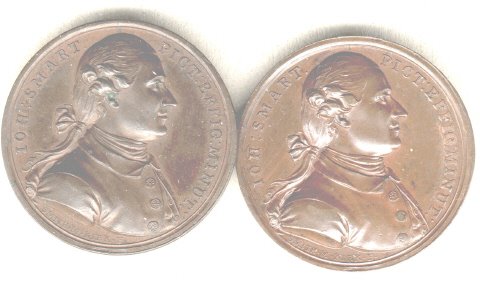
These two identical bronze medals are of the miniature painter John Smart. The reverse is blank in both cases. In her book about John Smart, Daphne Foskett comments on the medal as follows.

"A medal bearing his portrait, modelled by Joachim Smith and cut by John Kirk, of which there are several versions, was struck in 1777, no doubt to celebrate the year he became Vice-President. At least two silver medals are known to exist, one engraved on the back "September 22, 1798". Several were struck in bronze, one in my own collection having "Sarah Neale" engraved on the reverse, and at least one has come to my attention made of a siver alloy." 681

Monday

Andras, Catherine - portrait of King George III


This miniature portrait is in wax and is signed below the bust "C Andras A D 1820". Catherine Andras (1775-1860) was a wax modeller who worked in London. This wax model of George III is recorded in Pyke's Dictionary. On the rear of the frame there is a typed note recording "Inside the back of this frame is the origimal receipt made out as follows :- Portrait of / His Late Majesty George the Third/ Modelled by Catherine Andras / Modeller in Wax to His Late Majesty / Published (?) as his aide directed July 4th 1821 / No. 30 Pall Mall / 2 Guineas". 1093

Friday

Harding, George - portrait of John Maynard


This miniature portrait is signed "G P Harding del 1811" for George Perfect Harding" (1780-1853). The portrait is inscribed "To John Maynard Kt". This appears to be a copy of the portrait of Sir John Maynard (1602-1690) by John Riley (1646-1691) that hangs in the NPG London. 175

Unknown - portrait of a man


This unsigned miniature portrait is oil on copper. Although included under British, it may be European. 328

Thursday

Donaldson, John - portrait of William Pitt the Younger

Although unsigned, this miniature portrait has been attributed to John Donaldson (1737-1801), a Scottish artist who also worked in London.

One of the bracelet clips at the rear is engraved "Rt Hon'ble William Pitt" for William Pitt (28 May 1759 – 23 January 1806) the famous British Prime Minister of the late 18C. He was the son of William Pitt the Elder (1708-1778), who was Prime Minister of Great Britain (1766-1768).

William Pitt the Younger became the youngest ever Prime Minister of Great Britain between (1783-1801) and again between (1804-1806).

It appears from the clothing and wig style that Donaldson painted the portrait in the mid 1780's and has slightly emphasized Pitt's youth, as he has given him softer features than the 1787 Gainsborough portrait of Pitt.


Comparison can be made with three other large oil portraits of William Pitt the Younger, all painted around the period 1785-1790 which are illustrated here. The one on the right, painted by Thomas Gainsborough c1787, appears in William Hague's biography of William Pitt.

Thus the miniature was probably painted in 1784 or 1785, shortly after the time Pitt became Prime Minister in 1783.

Pitt never married and it seems possible that the miniature was painted at the request on his mother, who must have hoped he would marry.

In 1783 he was reputedly offered as a wife, the seventeen year old daughter of the fabulously rich French politician Jacques Necker, and much later in 1796 there was some expectation that he would marry Lady Eleanor Eden, the attractive daughter of Lord Eden.

The miniature is believed to be genuine, although it is difficult to be 100% sure. However, it should theoretically be possible to confirm or disprove the identity of William Pitt as the sitter, by taking a DNA sample from the lock of hair contained in the reverse of the locket.

The locket case with the hair back is similar to, but less elaborate than one of similar date on page 325 of Foskett. The engraved bracelet clips on this miniature appear to have been added slightly later. This was not uncommon and there are various miniatures in this collection that had bracelet clips or brooch pins added after the date of the original miniature.

For much more about William Pitt, see William Pitt the Younger - Wikipedia, the free encyclopedia

For a second miniature of William Pitt in this collection see View 1135

Wednesday

Thomson, William J - portrait of John Gloag


This miniature is signed and dated 1814 on the reverse. The artist is William John Thomson (1771-1845). He was born in Savannah in the United States, but for much of life he worked in Edinburgh, Scotland. The sitter is identified as John Gloag. 931

Unknown - portrait of Sir Walter Scott


This miniature portrait is by an unknown artist, but the sitter is Sir Walter Scott, the famous Scottish author. 985

Tuesday

Unknown - portrait of Seth William Stevenson


The painter of this miniature portrait is not known. However, it is inscribed on the reverse "celebrated numismatologist. Stevenson, Norwich. Father of Adelaide who married John Deighton of Cambridge." Thus the sitter is identified as Seth William Stevenson who wrote a 929 page book entitled "Dictionary of Roman Coins". This was published in 1889 after his death and remained in print for about another 100 years.

In the 1851 cenus, Seth William Stevenson was a widower, his wife being Mary (1801-<1851). He was then aged 63 and is recorded as the co-proprietor and editor of the Norfolk Chronicle weekly journal. In 1851 he lived at 173 Surrey Street Norwich, along with his daughter Adelaide, then aged 21 and his son Henry aged 18 who later assisted the completion of the book after his father's death. 1061

Dixon, Annie - portrait of a youg girl


This miniature portrait is inscribed on the reverse, "by Miss Dixon Horncastle and No. 5 Fitz Roy House(?), Fitz Roy Square". The name of the sitter is also shown, but unfortunately a previous owner has crossed this out so it is illegible. This probably happened when it was sold out of the family. 302

Dixon, Annie - portrait of young girl


This miniature portrait is signed on the reverse, "Portrait painted by Miss A Dixon, Horncastle". This is for Annie Dixon (1817-1901). The sitter is unknown. 303

Macleay, Kenneth - portrait of a lady


This miniature portrait is signed 'K MLeay 1834" for Kenneth Macleay (1802 -1878) . The sitter is unidentified. 301

Tayler, Charles Foot - portrait of old lady


Both these miniature portraits are signed "C F Tayler 1820" for Charles Foot Tayler (1800 - 1853). He came from the Isle of Wight, but painted in Bath for many years. The portraits are interesting, as they would have been painted at the same time, but for different members of the sitter's family. One came from California and one from Kent, England, so it was nice to reunite them.

The sitter is unknown, but one of them has an inscription on the rear "Princess of Stacia. Painted by C F Taylor 1820". However, this name has not yet been traced. 1106, 1187

Tayler, Charles Foot - portrait of a young man


This miniature portrait is signed "C F Tayler 1821" for Charles Foot Tayler (1800-1853). The sitter is unknown. 24

Durham, Cornelius Bevis - portrait of a young man


This miniature portrait is signed by Cornelius Bevis Durham (7 Jun 1809-1884) and active (1825-1865). He was born in St Clements Dane, Middlesex and died in Christchurch, Hampshire in June 1884.

Durham can be tracked quite readily through the census records but a decline in his income due to competition from photography seems to become apparent. In 1841 he lives in Marylebone with his wife, Mary, three son, one also named Cornelius aged 4, the others being Edmund, 3 and Francis, 1 and there are also two female servants.

In 1851 he is an artist living in Marylebone with his first wife Mary, but only one son George aged 3 and one servant. However, he also seems to have various relatives or lodgers living with him, including a bazaar keeper and a newspaper seller.

In the 1861 and 1871 census records Durham describes himself as an artist and is now living near Brighton Pavilion in a large household, headed by his cousin Martha Phillips, who is a wealthy tea merchant. Mary his wife is there in 1861, but in 1871 he is a widower.

Durham can also be found in the 1881 census, but is now living in New Barnet with his son George and he gives his occupation as miniature painter. This is the only time he has used the occupation of miniature painter in the census records, all other times stating it as artist. He is then aged 71. His place of birth was St Clement Danes, Middlesex. He has remarried, this time to Mary Ann Upfill in 1872. He died in 1884.

The sitter is unknown. 87

Hamlet, T - portrait of a man


This miniature profile portrait is by T Hamlet. On the reverse there is most of his trade label. It is headed by the Royal Coat of Arms and under that reads;
"Hamlet, Miniature and Profile Painter to Her Majesty and the Royal Family, No 2 Old Bond Streeet Bath, takes the most striking likenesses on glass, paper, or ivory. A sitting of only one minute required. Large Shades reduced to any size. Profiles in Black from 2s 6d to L 1. 1s. Coloured from 10s 6d to L3. 3s. Prepared ivories for miniature painting and miniature Frames for sale. Ladies and Gentlemen waited on. Wood & Co. City Printing Office Bath."
The sitter is unknown. 295

Hancock, Robert - portrait of a lady


This miniature profile portrait is inscribed on the reverse, "Painted 28th Sept 1824 by R Hancock - very like". This is probably the Robert Hancock who lived in Bristol. It seems likely that the unidentified sitter is a sister or other close relative of the adjacent portrait. 552

Hancock, Robert - portrait of a lady


This miniature profile portrait is inscribed on the reverse "Painted 29 Sept 1824. Very like". As the adjacent portrait is signed Robert Hancock in the same hand writing, this portrait must also be by him. The two sitters are most likely sisters, but their identities are unknown. 554

Unknown - portrait of a lady


The artist and sitter are unknown, but this miniature portrait may be by Richard Crosse. 139

Various - portraits of Kingsley family


This group of miniature portraits are contained within a single frame. The sitters are all identified by very old notes inside the frame. The sitters include two ancestors of the famous writer Charles Kingsley who wrote "The Water Babies" and other books. Depicted are his father (bottom right) and his grandmother (top left). The other three images are believed to be related by marriage.

The man in the centre is James Wills and the following notes about him and his descendants are included in case they are of any interest to genealogists.

"James Wills who died 1731 married Martha Curtis and left 2 sons. (1) Godfrey, his heir - Lt Col Roscommon Militia (2) Robert of Annalee Co Carlow, and two daughters of whom one married Mr Lennox (?) a banker.

(Col) Godfrey Wills married (first) Sarah Montgomery of Ballinlongious (?) Co Monaghan - their children were (sons); (1) Thomas, his heir (2) Robert married Miss Dowely (?) (3) Caspar married Mr Carter's daughter. Daughters (1) Elizabeth married Thomas Mitchell of Castle Strange (?) Co Roscommon (2) Martha married Charles Wood of Larkfield Co Sligo (3) Sarah married Sir Ralph Fetherstone of Ardagh (4) Catherine married Ralph Owens (?) of Longford. (5) Susan married William Fetherstone of Carrick.

Col (Godfrey) Wills married secondly Charlotte Elizabeth, daughter of Luke Stirling of Mount Dutton Co Meath & had by her (4) (ie a fourth son) James Wills of Plas Bellin, who married Miss Kingsley. (5) Charles (6) Ann married William Berry of Eglish (?) Castle Kings Co.

Col Wills was succeeded by his eldest son, Thomas Wills of Willsgrove (?) who married in 1765 Jane Talbot - their children were (1) William Robert born 1779. (2) Sarah married Rev William McLoughlin (2) Elizabeth died unmarried (3) Ann married W D Burleigh, their son afterwards married the daughter of James Wills of Plas Bellin. (4) Jane died unmarried.

Godfrey the second of William & Susan Fetherstone, married in 1824 Matilda daughter of Rev Stephen Radcliff & his (her?) youngest sister Elizabeth married as her second husband, Rev Stephen Ratcliffe. Painewick (?) 30th July 1914.

The rear of the frame has a note saying "For my nephew Cecil Burleigh in New Zealand". 18

Unknown - portrait of James Wills

This unsigned miniature portrait is painted in enamel on copper. As it was painted around 1715-1725, the most likely artist was originally thought to be Christian Friederick Zincke (1683/4-1767), as there were very few painters in England painting enamel miniatures at this time. However, a kind and knowledgeable visitor to the website, advises it is not by Zincke, thus the artist is currently unknown.

The sitter is identified as "Jas Wills, grandfather of Jas Wills of Plas Bellin, died 1730". He is either the father or the grandfather of the James Wills in the portrait below which is signed Collins".

A marriage record has been found for him as James Wills (1675-1731) who married Martha Curtis of Dublin before 1723. In fact their marriage was probably closer to 1700, as their elder son Godfrey Wills married first, Sarah Montgomery on 6 Sep 1731. Godfrey Wills then married, second, Charlotte Elizabeth Stirling of Dublin on 6 Jun 1771. Godfrey and Sarah had a son called James Wills, who married Lucretia Ann Kingsley on 23 Nov 1801. Lucretia was the aunt of the author Charles Kinglsey.

There is a reference to a huge Elizabethan country house called Plas Bellin that is now a family refuge centre, see BBC - Beyond the Broadcast - Changing Places , but James Wills has not yet been confirmed as the owner in the 18C. 18a

Collins, Samuel - portrait of James Wills


This miniature portrait is signed "Collins" for Samuel Collins (1735-1768). The sitter is identified on several notes within the overall frame, as James Wills. However, there are conflicts within the notes, as one describes him as the son of the James Wills who died in 1731 and another describes him as a grandson. Judging upon his age and costume, it would seem more likely he is a son of the earlier James Wills. The notes mentioning him read as follows.

"James Wills, son of above and father of Robert, Godfrey, Lucretia E (Burleigh) and Charlotte Wills. Died 1854 age 83."

"James Wills 2 married Lucretia Anne Kingsley, had issue Robert Wills, Godfrey Wills, Lucretia m W Burleigh, Charlotte. He died 1854 aged 83."

If he died on 1854 at age 83, he would have been born in 1771, but the artist Samuel Collins died in 1768 and the costume of the sitter is from around 1765. Thus it seems more likely that the sitter is a generation older than the notes suggest. It seems more likely that he is Godfrey Wills, the son of the James Wills who died in 1731 and the father of the younger James Wills. Godfrey Wills married second, Charlotte Elizabeth Stirling on 6 Jun 1771.

Another alternative that could fit the chronology associated with his age and costume, is that he is the Charles Kingsley (1743-1786) who married Elizabeth Ann Westney (1747-?), the sitter in the next portrait, on 24 Nov 1778. This would make him the grandfather of the author, Charles Kingsley. 18b

Crosse, Richard - portrait of Elizabeth Kingsley


This miniature portrait is unsigned, but it has been attributed to Richard Crosse (1742-1810). The sitter is identified by several notes inside the rear of the group frame.

"Elizabeth Westney, wife of Charles Kingsley Esq of Lymington, Hants, mother of the Rev C Kingsley of Chelsea and of Lucretia A Wills, wife of James Wills of Plus Bellin, Wales."

"Elizabeth Kingsley nee Westney married Charles Kinglsey of Lymington, mother of Rev C Kinglsey of Chelsea & Lucretia Ann Wills, wife of James Wills."

Her marriage record has been located for 24 Nov 1778, at St Anne Soho. Lomdon. Her son Charles Kingsley (1781-1860) was born on 23 Oct 1781. He was the father of the author Charles Kingsley, thus Elizabeth was the author's grandmother. 18c

Unknown - portrait of Major Stirling


This miniature portrait is unsigned. The sitter is idneitfied on notes inside the group frame as Major Stirling.

"Major Stirling, uncle of James Mills of Plas Bellin."

"Major Stirling, uncle of James Wills (2) of Plas Bellin Northop Wales."

It seems that he must have been a brother of the Charlotte Elizabeth Stirling who married Godfrey Wills on 6 Jun 1771.

There was a Major Stirling with the 42nd Highland Regiment, the Black Watch, who acted heroically in Egypt during the Nile Campaign, but it is not known if this is the same Major Stirling. 18d

Unknown - portrait of Rev Charles Kingsley


This miniature portrait is unsigned. The sitter is identified by notes inside the group frame as Rev Charles Kingsley.

"Rev C Kingsley of Bottomsby (?) and Chelsea. Brother of Lucretia A Wills and father of Rev C Kingsley, of George and Henry and George Kingsley."

"Rev Charles Kingsley of Chelsea, father of Canon Charles Kingsley, rector of Eversley and brother of Lucretia A Wills (nee Kinglsey) - uncle of Robert, Godfrey, Lucretia and Charlotte Wills. Lucretia E Wills married William Burleigh of St Catherines Carrickfergus."

The Rev Charles Kingsley (1781-1860) married Mary Lucas (1782-1873) in 1808 at Christchurch Parish in Barbados. They had five sons and a daughter. The author Charles Kingsley (1819-1875) was the eldest of their sons. For more about him see Charles Kingsley 18e

Unknown - portrait of a lady


Although neither the artist who painted this miniature portrait, nor the sitter are known, it is of very high quality for a profile portrait. On the reverse of the frame the date 1824 has been scratched and that seems a likely date. It is most probably British, but could possibly be American. 598

Uwins, Thomas - portrait of Lady Collins


This miniature portrait is by Thomas Uwins (1782-1857). On the reverse is is inscribed "Lady Collins. Painted by Thos Uwins Oct 1816". 341

Thompson, Thomas - portrait of a man


This miniature portrait is signed with the initials "T T ", and it has been attributed to Thomas Clement Thompson (1778-1857). The initials of the sitter "R A C" are on the reverse in gold filigree. 400

Buck, Frederick - portrait of a man

Although this miniature is unsigned, it appears to be painted in the distinctive style of Frederick Buck (1771-1840) of, Cork, Ireland.

Daphne Foskett comments; "During the Peninuslar War, when Cork was a busy port of embarkation, his services were in great demand to paint portraits of officers. In order to keep pace with demand, he kept a supply of painted ivories to which he added the heads and regimental facings as required."

and "His work is not as good as his brother Adam Buck and the features are often badly drawn and modelled; he used a rather hot colouring which looks hard and reflects the haste with which he so often painted. He sometimes painted cloudy sky backgrounds on the reverse of the ivory which he left blank on the front."

The design of the reverse of the case, is often found on Irish miniatures and this form of case design made its way across the Atlantic with Irish artists who emigrated to the United States.

However, a kind visitor has also suggested that another potential artist for the miniature may instead be by Henry Kirchhoffer (1781-1860) who was also from Ireland and painted in a somewhat similar style, although he was a little more original than the "cookie-cutter" style of Frederick Buck.

In the meantime, both names are offered for any further comment.

The reverse has the initials of the sitter "E J" in filigree gold, but otherwise the sitter is unknown. 644

Watling, Thomas - portrait of a man


Comparison of this miniature by Thomas Watling can be made with a recent record sale for a work by this artist, referred to below.

The Watling miniature in this collection is shown here in front and rear views. Also shown much enlarged is the signature "T W", which is faint as it was difficult to scan through the glass. The "T" and "W" are formed in the same manner as the example from the miniature of John White, and as if by an engraver, which was Watling's profession. However, it is conceded the initials may be meant to be "J W" or "I W".

In Foskett, there are no other obvious contenders with the initials "T W" and working around 1795-1805, which appears to be the date of this case. Foskett observes that Watling was working in Calcutta in 1803, and this was presumably after being released in Australia.

More recent research notes that he returned to Britain in 1804 and presumably continued painting there. Given the ornate frame, it seems possible this second miniature dates from after his return to Britain.

There is a small booklet about Thomas Watling which was produced to accompany a 1988 exhibition about him and his work in Dumfries, Scotland.

When acquired, this miniature was attributed to Thomas Watling and the sitter was said to be related to the Macquarie family who were early settlers in Australia. The rear does include initials which appear to read "M F". However, to date, no research has been undertaken to try and find an early Australian settler with the intitials "M F", but it seems a little unlikely that the sitter has an Australian connection.

However, if any researcher familiar with early Australian history, can suggest a suitable name, I would be very grateful. Of course, one obvious Australian explorer with the initials "M F", is the navigator and cartographer Matthew Flinders (1774-1814), but this sitter looks to be too old to be Flinders.

It can be compared with one interesting miniature sold in late 2007 by Gorringes. A big surprise, it was this unframed miniature by the Australian convict and artist Thomas Watling (1762->1806). It was signed and dated 1792, the year Watling finally reached the colony in Australia, after being sentenced to 14 years for forging banknotes in Dumfries.

The miniature depicts John White, the chief surgeon for the First Fleet, the 11 ships that sailed to Botany Bay in 1786 to establish a convict settlement in Australia.

After his arrival, Watling made many drawings which form the basis of the important studies of wildlife, landscapes, and the indigenous people of Australia known as the Watling Collection, now housed in the zoological library of the Natural History Museum in London. He was pardoned in April 1797, see Watling, Thomas (1762 - ) Biographical Entry - Australian ...

The miniature was offered for sale by Gorringes in Sussex, England on 6 December 2007, seeking an opening bid of GBP120 and with an estimate of GBP200/400. I was tempted to leave an absentee bid of GBP550, well over the estimate to have a good chance of winning, but in the event did not bid.

To the astonishment of everyone, me included, but excepting the two bidders concerned, there were 405 bids according to the eBay auction record, which took the hammer price to GBP90,000, say $210,000 including buyer's commission.

To the best of my knowledge, this is a record price for any miniature sold at a combined live/eBay auction.

In reporting on the sale Antiques Trade Gazette - News & Analysis comments; "On his arrival, he was very quickly assigned to John White. White had become Surgeon General of New South Wales and, as an ardent naturalist who was collecting and documenting specimens, he made use of Watling�s artistic talents. Over the next two years Watling made many drawings which form the basis of the important studies of wildlife, landscapes, and the indigenous people of Australia known as the Watling Collection, now housed in the zoological library of the Natural History Museum in London. Indeed, many of the drawings are annotated in John White's hand. John White does have a connection to East Sussex since, after he returned to England, he spent his last years living in Brighton and died at Worthing in 1832."

Also "Watling's only major known surviving work is Sydney in 1794, a large oil painting which hangs in the Dixson Gallery, Sydney. There are some sketches and finished drawings, a few of which have appeared on the market, but the discovery of this miniature appears to be something of a first."

However, as there are now two miniatures by Thomas Watling, it suggests there are more waiting to be found. 340

Fischer, Johann Georg Paul - portrait of a man


This miniature portrait is signed "J P F" for Johann Georg Paul Fischer (1786 - 1875). He did sign in several different ways and the adjacent portrait by him is signed Paul Fischer. The sitter is unknown. 822

Fischer, Johann Georg Paul - portrait of a man


This miniature portrait is signed on the reverse "Paul Fischer" for Johann Georg Paul Fischer (1786-1875). The sitter is unknown. 373

Bogle, John - portrait of a man


Although this miniature portrait is unsigned, it has been attributed to John Bogle (1746-1803). The sitter is unknown. 640

Redmond, Thomas - portrait of Major French


This miniature portrait is signed "I R (or T R) 176?). It has been attributed to Thomas Redmond (c 1745- 1785). It is inscribed on the reverse "Major French who married Mrs Donnellan. Drowned coming from Margate". It seems likely that he is either the same person, or perhaps more likely is closely related to the sitter in the adjacent portrait. At french1 there are references to two brothers, both called John French. They both seem to have died in 1775 and one of them married Frances Donellan in 1775. 305

Redmond, Thomas - portrait of John French


This miniature portrait is signed either (I R (or T R) 1762". It has been attributed to Thomas Redmond (c1745-1785). The reverse of the portrait is inscribed "John French who was to have been Lord Dungar. Drowned coming from Margate". It seems likely he is either the same person, or perhaps more likely a close relative of the sitter in the adjacent portrait. At french1 there is a reference to two brothers, both of whom appear to have been called John French and both seem to have died in 1775. One of them married Frances Donellan in 1775. 306

Unknown - portrait of a Victorian soldier


Although neither the artist nor the sitter are known, this miniature portrait of a Victorian soldier is extremely well painted. 128

Monday

Unknown - portrait of The Hon Augustus Henry Archibald Anson VC

This miniature portrait on ivory was acquired in 2001 and has sat since posted on this site in 2006, as unsigned, with the sitter unidentified.

It is rare to be able to identify a sitter, but now in late October 2007, almost exactly 150 years to the day since he earned the Victoria Cross, it has been possible to identity the sitter from his clothing, i.e. his uniform and two medals, the Victoria Cross and the Indian Mutiny Medal.

Research has determined that the sitter is the Hon. Augustus Henry Archibald Anson VC (5 Mar 1835-17 Dec 1877), a son of the Earl of Lichfield. In 1863 when he was aged 28, he married Amelia Maria Claughton (4 Jun 1843-4 Jan 1894). Amelia was the daughter of the future Bishop of St Albans, the Right Rev. Thomas Leigh Claughton. They seem not to have had any children.

It is likely the two colours of woven hair on the reverse side of the miniature are those of Anson and of Amelia. Possibly this hair could be used to confirm the sitter's identity using DNA analysis.

Anson's father the Earl of Lichfield was Postmaster-General from May 1835 to Sep 1841 and during his administration the universal penny-postage system was brought into operation. This featured the first ever postage stamp, the Penny Black, and was championed by Sir Rowland Hill. For more see Penny Black - Wikipedia, the free encyclopedia

However, when Augustus was only seven years old in 1842, the Earl of Lichfield fell into serious pecuniary difficulties. His magnificent mansion in St James Square was dismantled and its contents dispersed by the hammer of Mr George Robins, as were those also of his country seat at Shugborough where the same official held a sale for twelve days. The Earl had earlier been a "warm supporter of the turf" and in 1836 his horse Elis won the St Ledger.

The logic behind the attribution of the miniature is as follows. The sitter is an army officer wearing both the Victoria Cross and the Indian Mutiny medal. His rank badges appear to be those of a Lieutenant-Colonel. His age in the portrait could well be 28 and thus fit with this being a miniature painted at the time of his marriage in 1863.

The miniature must be one of the very early, if not the earliest, contemporary painted portrait of a winner of the Victoria Cross wearing his medal. As such it is of considerable rarity, although obviously not in the class of a Victoria Cross medal itself, as they usually sell for an average of around GBP150,000.

The Victoria Cross was created in 1856 and the first Victoria Cross investiture was carried out in June 1857, when 62 winners were invested. The Indian Mutiny medal is also shown here, with this example having the Lucknow clasp. A kind visitor has pointed out that Anson won three clasps, although only one is shown in the miniature. This was probably artistic licence, to enable the colour of the ribbon to still be seen. For much more about the Victoria Cross, see; The History of the Victoria Cross, The Victoria Cross Society for enthusiasts , and Victoria Cross Research - research@victoriacross.co.uk - Designed ...

A total of 182 Victoria Crosses were awarded during the Indian Mutiny and the recipients are recorded along with other Victoria Cross winners in the book "The Register of the Victoria Cross" published in 1997.

In almost all cases, pictures of the winners of the VC are included in the book. By a process of elimination, the 182 winners in the Indian Mutiny were reduced to about 50 recipients who had a VC won in the Indian Mutiny and who subsequently achieved an army rank of Lieutenant-Colonel or higher during their career. However, of the 50, there were only three or four whose highest rank achieved during their military career was Lieutenant-Colonel.

While this does not make it certain it was the highest rank this sitter achieved, it does make it more likely. Additionally, the book contains the photograph shown below of Hon Augustus Henry Archibald Anson, which is remarkably similar to the miniature, although he appears a little older. Anson died in France in 1877 when he was only 42. The cause of death is unknown, but being in France and at such an early age, one might suspect it was possibly at a tuberculosis sanatorium?

Anson seems to have entered the army as an ensign in 1853 in the 44th Foot via purchase of the rank. He served in the Crimea 1854-56 and also in China 1857-1860. Being from a wealthy family he would not have needed to pursue an army career for his whole life and when he retired, he had achieved the rank of Lieutenant-Colonel in the 84th Regiment (later the York and Lancaster Regiment). He appears to have resigned his commission around the time of his marriage, possibly due to ill health. He became MP for Bewdley from 1869-1874.

The citation for his VC is as follows; "On 28 September, 1857 at Bolandshahr, India, the 9th Light Dragoons had charged through the town and were reforming on the Serai, when the enemy tried to close the entrance by drawing their carts across it. Captain Anson, taking a lance, dashed out of the gateway and knocked the drivers off their carts. Owing to a wound in his left hand, he could not stop his horse and rode into the middle of the enemy who fired upon him. At Lucknow, on 16 November 1857 he again showed great gallantry when he entered with a storming party on the gates being burst open; his horse was killed and he was slightly wounded."

The date of 16 November, 1857 is significant as this is the day when the most ever awards of the Victoria Cross were made on one day, with 24 recipients. Thus Anson was one of these 24. His Victoria Cross is located at Shugborough estate, Milford, see Location of Augustus Anson's Victoria Cross

Contained within the National Portrait Gallery in London there is a large oil painting titled "The Relief of Lucknow, 1857" painted by Thomas Jones Barker in 1859. Purely for convenience, the central part of it is shown here, with more information being on the MOD website at www.army.mod.uk/.../the_indian_mutiny.htm

A number of those involved in the Relief of Lucknow and shown in the painting, are identified in the record of the painting as held by the NPG, including Major Hon A H Anson who by then had been promoted from Captain, see Major Hon. A. H. Anson

However, as the NPG does not show birth/death dates for Major Anson, nor does it refer to his award of the VC, it appears their research department has not yet made the connection. Two other VC winners in the painting also seem not to have not yet been identified by the NPG; Major Probyn (Sir Dighton MacNaughton Probyn (1833-1924) and Captain Watson (Sir John Watson (1829-1919) , see below.

Interestingly, a comparison of the names of the 29 men depicted in the painting, against the names of winners in the Register of the Victoria Cross, shows that only five of those depicted won the Victoria Cross during the campaign, despite 182 being awarded. Thus, the qualification for inclusion in the painting appears to be mainly birth, rather than gallantry.

The VC winners depicted in the painting and their affiliation are believed to be;

Hon Augustus Henry Archibald Anson (1835-1877) of the 84th Regiment
Thomas Henry Cavanagh (1821-1882) of the Bengal Civil Service
Sir William Peel (1824-1858), of the Royal Navy, although he won his VC in 1854 during the Crimean War
Sir Dighton MacNaughton Probyn (1833-1924) of the 2nd Punjab Cavalry
Frederick Sleigh Roberts, 1st Earl Roberts (1832-1914) of the Bengal Artillery
Sir John Watson (1829-1919) of the 1st Punjab Cavalry

One other VC winner not in the painting, but who may cause confusion is Sir Henry Marsham Havelock VC. The painting is said to include Sir Henry Havelock Bt (1795-1857) who died of dysentery at Lucknow on 24 November, a week after the Relief. However Sir Henry Marsham Havelock (1830-1897) won a VC at the Relief of Lucknow. Closer inspection of the painting should confirm it is the elder of the two who is actually depicted.

From the above analysis, it appears that Anson was the only infantry officer to both win a Victoria Cross, and be depicted in the painting, "The Relief of Lucknow".

For more about Anson, see Augustus Anson - Wikipedia, the free encyclopedia He is buried in France, see Augustus Henry Archibald Anson (1835 - 1877) - Find A Grave Memorial

After the death of her husband in 1877, Amelia became on 13 Aug 1881, the second wife of the 8th Duke of Argyll. She died on 4 Jan 1894. 444

Nash, Edward - portrait of an officer


This miniature portrait is unsigned, but has been attributed to Edward Nash (1778-1821). The sitter is unknown. 752

Cosway, Richard (copy) - Anne Damer


This miniature portrait is believed to be an early 19C copy of a portrait by Richard Cosway. The sitter is Anne Seymour Damer (1749-1828), a noted English sculptor. She inherited most of the estate of Horace Walpole. 831

Plimer, Andrew - portrait of Lady Langham


This miniature portrait is unsigned, but has been attributed to Andrew Plimer. The sitter is described on the reverse as "Lady Langham". 250

Gibson, David - portrait of a lady


This miniature portrait is signed "Gibson 1800", probably for David Gibson (active 1788-1800), a Scottish artist. The sitter is unknown. 564

Shirreff, Charles - portrait of Robert Spottiswoode


This miniature portrait is attributed to Charles Shirreff (1750-1831). The frame is inscribed with the name of the sitter "Robert Spottiswoode 1788(?)". 442

Unknown - portrait of Elizabeth Barrett Browning


The artist of this miniature portrait is unknown, but the sitter is Elizabeth Barrett Browning, the English poet. 242

Unknown - portrait of Robert Browning


This miniature portrait is by an unknown artist, but is of Robert Browning the English poet. 241

Unknown - portrait of Queen Victoria


This miniature portrait appears to be of Queen Victoria before she was crowned. She is wearing the blue sash of the roylty and is sitting on a throne with the Royal Cypher "G R" above her head. The artist is unknown. Another similar portrait of her is located at the following address - academic.brooklyn.cuny.edu/history/virtual/portrait/victoria.jpg 1002

Unknown - portrait of a man


Artist and sitter are unknown. 682

Unknown - portrait of a man


The artist and sitter are unknown. 355

Unknown - portrait of Christopher Wren


This miniature portrait is by an unknown artist. It is attached to a human hair bracelet. It is housed in its original red leather horse-hoof shaped box. This is engraved with red gilt lettering which appears to read "C. W. & J. C. K.". The box also has a jewellers' gilt stamp of "Cook & Burchett 150 Oxford Street London W". The portrait is believed to be of a descendant of Sir Christopher Wren, possibly also called Christopher Wren. The initials would be of the sitter and his bride, but to date it has not been possible to make any closer identification. 19

Meyer, Jeremiah (?) - portrait of a man


This unsigned miniature portrait is similar in style to Jeremiah Meyer (1735-1789).

However, it may possibly be by a Scottish artist, perhaps John Donaldson (1737-1801) or John Bogle (1746-1894). Another possibility may be the Irish artist, Richard Bull (1755-?), signed examples by him are scarce. The sitter is unknown. 1046

Meyer, Jeremiah - portrait of a man


This miniature portrait has been attributed to Jeremiah Meyer (1735-1789). It is unusual for him to paint hands, but there is a portrait in the Royal Collection by him, which shows hands painted in a similar manner. The sitter is unknown. 296

Meyer, Jeremiah - portrait of a lady


This miniature portrait is unsigned, but has been attributed to Jeremiah Meyer (1735-1789). The sitter is unknown.

Unknown - portrait of lady in hair bracelet


This miniature portrait is by an unknown 18C British artist. It is set in a low carat gold case attached to a woven human hair bracelet. The sitter is unknown. 115

Cooper, Samuel (copy) - portrait of Oliver Cromwell


This miniature portrait appears to be a 19C or 20C copy on copper of a famous portrait of Oliver Cromwell by Samuel Cooper. 654

Oliver, Isaac (copy) - portrait of a man


This miniature portrait is a 19C copy of an early miniature portrait by Isaac Oliver. The original is in the Orange-Nassau Collection. 186

Unknown - portrait of Lord Byron


The painter of this miniature portrait is unknown. The sitter is Lord Byron and as he is shown above dark clouds, it would most likely have been painted after his death. 609

Unknown - portrait of Lord Byron


The painter of this miniature portrait is unknown. The sitter is Lord Byron. 769

Robertson, Andrew - portrait of Lord Byron


This miniature portrait has been attributed to Andrew Robertson (1777-1845). It is believed to be a portrait of Lord Byron. 360

Lens, Bernard - portrait of a lady


This miniature portrait has been attributed to Bernard Lens (1682-1740), but it may be by another artist from that era. It is in an early fruitwood frame. The sitter is unknown. 97

Beale, Charles (?) - portrait of a man


This miniature portrait had been attributed to Charles Beale the Elder (1631-1705), but more recent scholarship suggests that may not be the case.

The technique looks more European than English and Beale is perhaps optimistic as an attribution, as the drawing of the face is a bit heavy handed for him and the costume a bit weak.It appears to be painted on vellum or card.

The sitter is unknown. 758

Chalon, John James - portrait of Queen Boadicea


This miniature portrait is inscribed on the reverse "Boadicea J J Chalon, purchased from the Grego(?) collection 1824". John James Chalon (1778-1854) was the brother of Edward Albert Chalon. 1105

Crosse, Richard (???) - portrait of a man


Although unsigned, this portrait has tentatively been attributed to Richard Crosse. The sitter is unknown. 1086

Miles, Edward - portrait of a man


This miniature portrait is unsigned, but has been attributed to Edward Miles (1752-1828). Although born in England, he moved to America and painted many portraits there. The sitter is unknown. 550

O'Keeffe, Daniel - portrait of a lady


This miniature is signed "D K 177?". It is probably by the Irish artist Daniel O'Keeffe, who was born Daniel Keeffe, but changed his name to O'Keeffe. The sitter is unknown. 542

Smith, Sophia - portrait of a child


This miniature portrait of a child is signed "S S 176?", probably for Sophia Smith who was active from 1760 to 1767. The sitter is unknown. 544

Vispre, Francois - portrait of a lady


This miniature portrait is signed "Vispre 1761", probably for Francois Vispre (1730-1794). The sitter is unknown. 838

Dixon, Charles - portrait of a man


This miniature portrait is painted by the artist Charles Dixon (1748?-1798?). The sitter is unknown.

Unknown - portrait of Frederick Duke of York


The painter of this miniature portrait is unknown. The sitter is Prince Frederick, Duke of York. 286

Unknown - portrait of King George III


The painter of this miniature portrait is unknown. The sitter is king George III. 287

Unknown - portrait of a man


The artist and sitter are unknown, but they are probably Irish. 123

Unknown - portrait of Queen Anne


The painter of this miniature portrait is unknown. The sitter is Queen Anne. It is a copy of a larger portrait and was probably painted in the mid to late 18C. 307

Stevenson, J - portrait of Jno Stevenson


This miniature portrait is signed on a slip of paper behind the portrait. It appears to read "Taken A D 1825 For Jno. Stevenson (Stevens?) aged at that time eighteen years. J(T?) Stevenson (Stevens?)".
The artist is believed to be J H Stevenson (1750-1833) of London. 365

Stevenson, J - portrait of a man


The framing of this miniature portrait is identical to the adjacent portrait and the style is very similar. Thus it has been attributed to J H Stevenson of London. 579

Kean, Michael - portrait of Mrs Samuel Keys


This miniature portrait is attributed to Michael Kean (1761-1823). It is inscribed on the reverse "Mrs Samuel Keys by Michael Kean"". It is unusual in that it is painted on porcelain. Michael Kean became a junior partner, and later married the widow of the owner, of the famous Derby Porcelain Factory and so became the owner of the factory until 1811. Nothing more is known about Mrs Samuel Keys. 586

Carrick, Thomas Heathfield - portrait of a man


This miniature portrait is by Thomas Heathfield Carrick (18112-1874). It is unusual in that it is painted on marble. The sitter is unknown. Carrick was awarded a medal in 1845 by Prince Albert for inventing a method of painting on marble. 484b

Carrick, Thomas Heathfield - portrait of a lady


This miniature portrait is by Thomas Heathfield Carrick (1802-1874). The sitter is unknown. It is unusual in that it is painted on marble. Carrick was awarded a medal from Prince Albert in 1845 for inventing the method of painting on marble. 484a

Schenley, Henrietta Agnes - portrait of Henrietta Araminta Monck Browne


This miniature portrait is by Henrietta Agnes Schenley (1847- ) who married Charles Nicholas Ridley in 1884 and thus became Henrietta Agnes Ridley. This miniature portrait is signed H Agnes Ridley.
In the 1901 census, she is living in The Lodge, South Warnborough, Hants with her husband Charles N Ridley, who was of independent means. They had a daughter Alberta M Ridley aged 15 , a governess and six servants. In the 1891 census, what must be the same family is living at the Grange, Groudhurst, Kent with Alberta aged 5 and five servants. Although the birth date is inconsistent, their daughter Alberta Mary Ridley appears to have been a god daughter of King Edward VII see List of godchildren of members of the British Royal Family ... It is currently thought that Henrietta Agnes Ridley was a daughter-in-law of the sitter, with her husband Charles Nicholas Ridley (1852-?) being a younger brother of the Henry C W Ridley (1848-?) referred to below.

Henrietta Agnes Schenley came from a very wealthy family. Although born in England in 1847, she was living with her parents and siblings in Collins, Pennsylvania, USA during the 1860 census, where her mother at age 34, disclosed real estate and other assets in her own right totalling $1,700,000. By 1871 the family was back in England.

There is a photographic portrait of Henrietta Agnes Schenley herself, taken about 1855 at http://www.lifeinwesternpa.org/viewDetail.asp?ID=315

Research has revealed that Henrietta's mother was Mary Elizabeth Croghan, who eloped at age 15 from a boarding school in New York, with Captain Edward Schenley. The boarding school was in fact run by Edward Schenley's sister in law Mrs McLeod. This caused an international scandel and is well documented on the Internet, see Oakland: People: Mary Croghan Schenley and her portrait here.

However, Mary and Edward they seem to have lived happily in England and had a large family. When Mary Elizabeth Croghan Schenley died in 1903, the Chicago Tribune reported her estate was worth about $40,000,000 to $50,000,000 and she was one of the richest women in the world.

On the reverse the miniature is inscribed "The Hon'ble Henrietta Araminta Monck Browne, wife of Maj Gen Charles Ridley C.B. b. 1816 d. 1869 - Painted by H. Agnes Ridley 1922". Their marriage took place in 1845 and Major General Charles William Ridley CB (1812-1867) served during the Crimean War. In 1865-67 he was Colonel of the 53rd Regiment of Foot, which in1865-68 was mainly serving in Ireland, and Canada.

Although it was painted in 1922, this miniature was acquired with the associated portrait of Napoleon presented to Lady Elizabeth Monck, and thus forms part of its provenance. The portrait of Napoleon is engraved as being a gift from Marshal Ney to Henrietta's Araminata Monck Browne's grandmother, Lady Elizabeth Monck.

In the 1851 census, Charles Ridley (then a Lt Colonel) and Henrietta were living at 78 Chester Square, Belgavia, London with their daughter Louisa Katherine Ridley (1846-1920), their son Henry C W Ridley (1848-?), and also five servants. Louisa married Marcus Talbot Delapoer-Beresford in 1895. 829

Duchesne - portrait of Napoleon

This miniature portrait has been attributed to Jean Baptiste Duchsene (1770-1856). The sitter is Napoleon. There is an engraved inscription around the bottom of the frame which reads "Given by the Emperor Napoleon to Marshal Ney who gave it to Lady Elizabeth Monck".

Research has identified Lady Elizabeth Monck as Elizabeth Araminta Gore (1770-1845), a daughter of Sir Arthur Saunders Gore, 2nd Earl of Arran. Although in 1783 Elizabeth married a commoner, barrister Henry Monck, she retained her courtesy title of Lady Elizabeth.

Lady Elizabeth was evidently a beauty of her day, as evidenced by the following quotation from a letter of August 1818, written by Sydney, Lady Morgan to Lady Clarke; "We only wanted the Hon. Mrs. Browne, who was married about the same time, when, lo! she entered with her mother, the beautiful Lady Elizabeth Monck, another of the charming clan of Arran, who for grace and beauty, when they were in their prime, could not have been matched in Europe. Lord Arran ought to have had some prize for the specimens of physical perfection he gave to the world in his daughters."

Lady Elizabeth had two daughters, the elder daughter, Elizabeth Araminta Monck married Vice Admiral Sir Charles Paget (1778-1839). They had a number of children including a son, Henry Horatius Paget who died in Malta in 1828.

Sir Charles Paget was one of several famous brothers, the eldest of whom was Henry Paget, Earl of Uxbridge and one of the Duke of Wellington's commanders at the Battle of Waterloo. Another Paget brother was Ambassador to Russia.

It therefore appears quite reasonable to expect that Lady Elizabeth Monck did meet Marshal Ney during Ney's trial after Waterloo, and could have asked him for a souvenir of Napoleon. For more on this portrait see a more detailed entry in the European 1 section of the collection, but also note the oil version by Duchesne here.

The second daughter of Lady Elizabeth Monck, was Catherine Anne Isabella Monck who married Dominick Brown 1st Lord Oranmore. Their daughter was Henrietta Araminta Monck Browne, see associated miniature portrait of her.

Lady Elizabeth Monck had a Grace and Favour apartment at Hampton Court Palace from 1829 to 1845. As an interesting aside, there is a reference to Lady Elizabeth Monck as a widow, at The Proceedings of the Old Bailey, London 1674 to 1834 in 1826 when a young man called William Andrews, was found guilty of stealing a bundle of laundry worth two pounds, from Lady Elizabeth. He was sentenced to be transported for seven years, probably to a penal colony in Australia. 830

Unknown - portrait of Captain Fitzroy


The painter of this miniature portrait is unknown. The sitter is Captain Fitzroy, who was ADC to the Duke of Wellington at the Battle of Waterloo. Captain Fitzroy later became Lord Raglan and commanded the British forces during the Crimean War. 308

Paduani - portrait of a lady


A previous owner attributed this miniature portrait to Paduani, but this has not been confirmed. 467

Unknown - portrait of Henry Ingles


The artist of this miniature portrait is unknown. On the reverse is written "The Reverend Henry Ingles D.D. Rector of Eastree, nr Winchester England. Formerly Head Master of Rugby School". During his time at the school a famous (infamous??) incident was The Great Rebellion" See Great Rebellion 766

Unknown - portrait of Mr Newenham

The artist is unknown. The frame is not original. 14

Unknown - portrait of Frederick Prince of Wales


This miniature portrait is a puzzle at present. There is an engraved inscription on the reverse which describes it as "H.R.H. Prince Frederick Louis of Wales eldest son of George 2nd by N Lagilliere". The Prince pre-deceased his father, George I, and thus never became king. The reference to Lagilliere is puzzling as Lagilliere only painted large portraits. It may refer to a copy of a portrait by Lagilliere, but he may not still have been alive when the Prince was the age in the portrait. It is also difficult to decide whether the portrait was painted in the 18C or 19C. However, it is well painted. 1067

Unknown - portrait of a lady


The artist and siter are unknown. The frame does not appear to be original. 112

Unknown - portrait of John Milton


This miniature portrait is by an unknown 19C artist. It is a portrait of John Milton (1608-1674), author of Paradise Lost. 839

Stroehling, Peter - portrait of unknown man


This miniature portrait is by Peter Stroehling, also called Peter Stroely. It is signed on the right "Stroehling 1805". The sitter is unknown. He is wearing Roman clothing. It is possible he was an actor, but it was also fashionable at the time for some people to dress in Roman clothing for portraits. 95

Plimer, Andrew - portrait of Viscount Andover


The reverse of this miniature portrait is engraved "Jane Elizabeth Viscountess Andover - Andrew Plimer". Thus although the attribution has not been confirmed, this portrait may be by Andrew Plimer.

Research indicates that Charles Nevison Howard, Lord Andover was born 13 May 1775 and died from an accidental discharge of his fowling piece on 11 January 1800. He had married Jane Elizabeth Coke on 21 June 1796.

However, it is possible that the case has been reused, as the style of dress appears to date after 1800. 869

Unknown - portrait of Helen Shelley

This artist is unknown, but the portrait is inscribed as being Helen Shelley who married a Mr Robert Parker (born 1754, wed 1782, buried at Bath 1837) of Bath. Helen Shelley (1755-1839) was the sister of Sir Timothy Shelley and he was the father of Percy Bysshe Shelley. This Helen Shelley was the aunt of the famous poet.

However, the clothes and hair seem too recent to be that Helen Shelley, as they date closer to 1820. Thus it is seems likely to be Helen Shelley (1799-10 May 1885), the sister of Percy Bysshe Shelley. This Helen Shelley appears not to have married.

There is an interesting reference in the Memoirs of the Life and Correspondence of Henry Reeve, C.B., D.C.L., by John Knox Laughton, to a letter to a Mr. E. Cheney dated January 23rd 1879.

"I saw Lady Shelley to-day, and, as I told her you could not call on her, she very obligingly said she would be happy to call on you and bring you the enlarged photograph of the poet to look at. These photographs are done on porcelain. There are only three copies of them, which Lady S. has got. The negative is destroyed. ... She says the drawing is the image of Shelley's sister, Helen Shelley." See In Two Volumes. Volume II. / Laughton, John Knox, 1830-1915

Comparison with one of these images, if any of them still exist, could help the identification.

The husband of Helen Shelley Parker was a wealthy man, as indicated by his will. From the will, they seem not to have had any children, so the sitter cannot be a daughter of Robert Parker, named Helen.

The will is recorded at 1837 Will of Robert Parker - nephew of ELIZABETH MORTON who was ... - but it can be summarised as;

* £60,000 of three pounds per centum Consols to wife Helen
* £10,000 of three pounds per centum Consols to E1izabeth the widow of Charles Bedford Young
* £5,000 of three pounds per centum Consols to Mary Ann Young
* £500 to Arriana wife of Aitkin Esquire formerly Arriana Shelley
* £100 to Godson John Shelley
* £50 to Godson Charles Parker Cally
* £50 to to Goddaughter Mary Day
* £50 to Goddaughter Louisa Scudamore
* £200 to Frances Jeffery, now North, who lived with his late mother and received an annuity which was to cease after Robert’s death
* £200 to her son Robert Jeffery
* the residual ready money to brother in law Sir Timothy Shelley Bart and Sir John Shelley Sidney Bart to invest on behalf of Robert’s wife during her lifetime and afterwards to be divided amongst cousins Thomas Marchant, John Marchant and the children of Robert‘s late cousin Mary Knight viz one equal share to Thomas Marchant one equal share to John Marchant one equal share amongst the children of WILLIAM MARCHANT and the remaining share amongst the children of Mary
* all third part shares in lands in Ifield and Charlswood (Westfield) and lands and castle at Otford in Kent plus farm and lands in Chevington in Suffolk, in Hargrove and Isfield and house in Catherine Place, Bath to Sir Timothy Shelley and Sir John Shelley Sidney
* all residual property for the use of wife Helen and after her decease to Thomas and John Marchant and the children of the said WILLIAM MARCHANT and Mary Knight in equal shares
* all jewels plate linen china carriage wines and other goods chattels to his wife
* £1,000 to Mrs Down
* £1,000 to Martha Isgrove
* £500 to each of the other servants

The will seems to have later been the subject of a Court Case:
HELEN PARKER v MARCHANT and Others
By order of Vice Chancellor Knight Bruce bearing date the 8th of March 1842 the following case was submitted for the opinion of the Judges of this Court. Robert Parker Esq was at the date of his will herein after set forth seised and possessed respectively of the following real and leasehold properties and of no other real or leasehold property that is to say Real property A freehold messuage or tenement and farm called The Great Lodge of Otford Park together with the barns stables lodges edifices buildings yards gardens orchards and appurtenances thereto belonging 1 and twenty one several closes or pieces or parcels of land thereto belonging containing by admeasurement 210 acres. A freehold messuage or tenement and farm called The Place Farm together with the granary barns stables oast houses lodges outhouses edifices and buildings and the ruins of the ancient castle and palace of Otford yards gardens orchards and appurtenances thereunto belonging and twenty seven closes pieces or parcels of land thereto belonging containing together by admeasurement 229 acres all which several messuages tenements lauds hereditaments and premises with the appurtenances are situate lying and being in the several parishes villages or hamlets of Otford and Kemsing or one of them in the county of Kent. A freehold plot piece or parcel of ground together with the messuage tenement or dwelling house thereon or on some part thereof erected and built being No 18 in Catherine Place in that part of the parish of Walcot in the county of Somerset which lies without the jurisdiction of the city of Bath. A freehold messuage tenement or farm barns stables buildings orchards gardens lands meadows pastures feedings coppices shaws and wood grounds thereto belonging with the appurtenances situate lying and being in the parish of Ifield in the county of Sussex and containing together by estimation in the whole 55 acres A freehold messuage tenement or farm barn stables buildings orchards gardens backsides lands meadows pastures feedings woods underwoods coppices shaws and appurtenances whatsoever thereunto belonging containing by estimation 45 acres situate lying and being in the said parish of Ifield in the said county of Sussex. A freehold messuage tenement or farm and barns stables outhouses and buildings thereunto belonging and several pieces or parcels of laud arable meadow pasture and woodland situate lying and being in the parish of Charlewood in the county of Surrey One etc. etc.......

The judgement was; The testator, after several pecuniary bequests and a bequest of the residue of his "ready money" securities for money, and money in the funds, to trustees proceeded thus; "As to to my messuages, lands, tenements, and real estate, I do dispose thereof as follows and then he specifically devised to the same trustees, certain freehold estates and all other my messuages, lands, tenements, and hereditaments which may not be herein particuiarly described or mentioned, upon certain trusts. The testator possessed no other real estates besides those mentioned but he possessed certain leasehold property at Bath and elsewhere. Held that the leaseholds did not pass to the trustees. Scott's New Reports in the Court of Common Pleas and Exchequer ... - Google Books Result- 916

Bingham, Margaret - portrait of Robert Dudley


This miniature portrait was painted by Margaret Bingham, also known as Countess Lucan. It is inscribed "Robert Dudley - Earl of Leicester". 657

Bingham, Margaret - portrait of Earl of Somerset


This miniature portrait was painted by Margaret Bingham, also known as Countess Lucan. It is titled at the foot "Carr, Earle of Somerset". 655

Bone, Henry Pierce - portrait of Earl of Salisbury


This miniature portrait is painted in enamel. On the reverse it is inscribed "Sir Robt Cecil E of Salisbury Painted by Henry Pierce Bone Enamel Painter to Her Majesty H.R.H. Prince Albert & etc. & etc. Orig by Zucchero London Jan'y 1847". 642

Bone, Henry Pierce - portrait of Lord Byron


This miniature portrait is painted in enamels. On the reverse it is inscribed "Byron after T Phillips R.A. Aug 1849 Painted by Henry P Bone Enamel Painter to Her Majesty H.R.H Prince Albert & etc, & etc." 240